Ryan J. Ross, CFA
Former Co-CIO & PM • 15+ Years Buy-Side

The real fiduciary risk isn’t the bad buy.
It’s the undocumented hold.
Most RIAs can explain why they bought a position. Far fewer can document why they still own it. The Portfolio Decision System is a structured, recurring re-underwriting process built into your existing investment workflow.
Most RIAs can explain why they bought a position.
Far fewer can explain why they still own it.
Positions often remain in portfolios long after the thesis, valuation, concentration, or risk profile has changed.
This is not a research problem. It’s a decision process problem
Concentration drift
NVDA grew from roughly 1% of the S&P 500 to nearly 8% between 2021 and 2025.
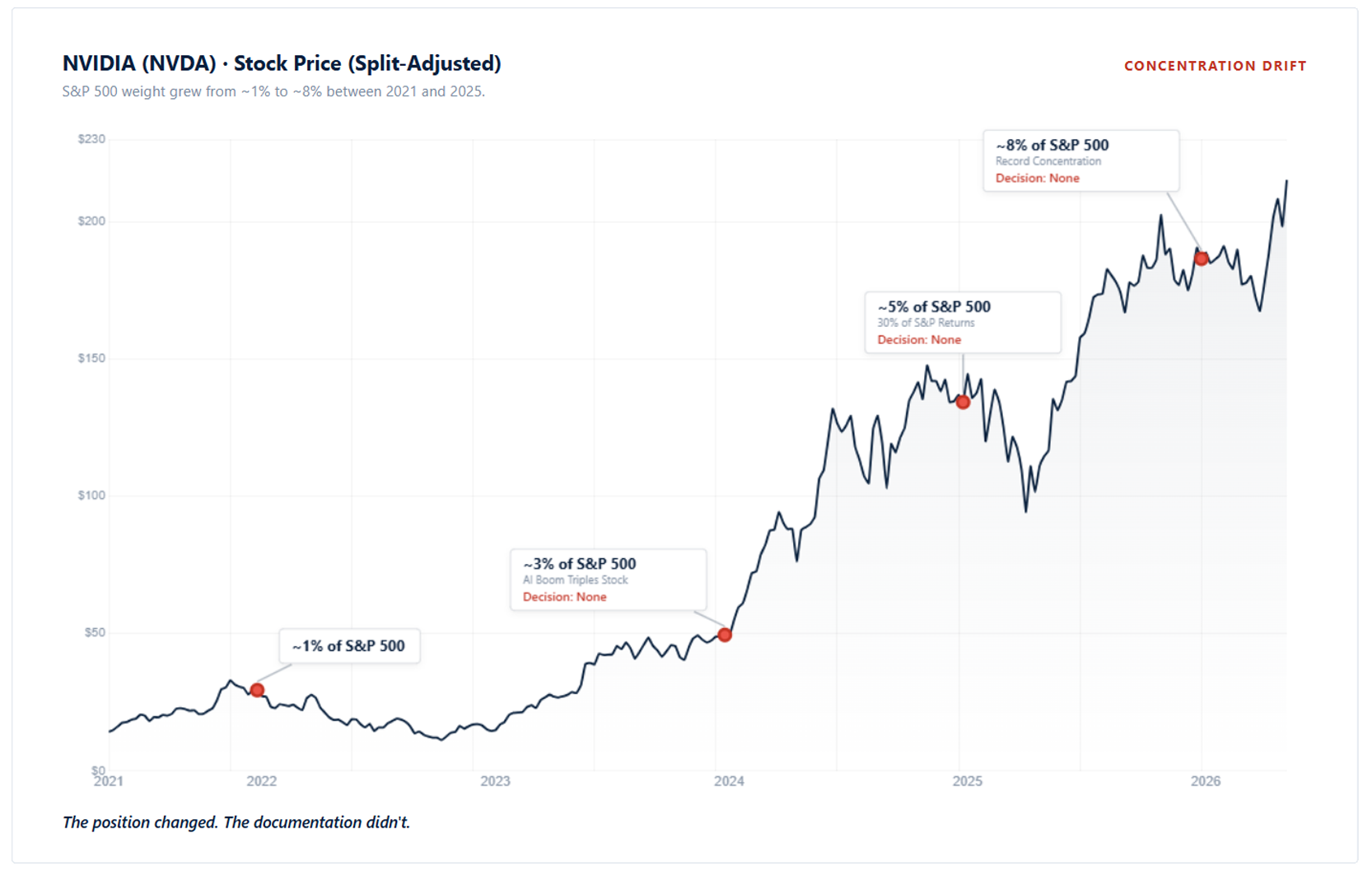
The position changed.
The documentation didn’t.
This isn’t just NVDA. Every ongoing exposure drifts over time, silently altering the risk profile of the entire portfolio.
Individual stocks. ETFs. Active funds. Passive allocations. Asset allocation shifts. Duration bets. Sector tilts.
If it remains in the portfolio, it deserves an explicit, current, and documented rationale.
Why this matters more now
The standard for fiduciary oversight is undergoing a fundamental shift.
"Was the recommendation reasonable at purchase?"
"Can the adviser demonstrate ongoing reassessment as conditions changed?"
Regulatory Precedent
Recent SEC enforcement actions — including Madison Capital ($900K penalty, February 2026) — reflect increasing scrutiny around stale assumptions, undocumented hold decisions, and failure to reassess as conditions evolved.
The SEC charged negligence-based violations despite the absence of realized client harm and after the firm had already remediated the issue.
The process failure itself was actionable.

You have a CCO for your trades.
You have an auditor for your financials.
Who is auditing your research?
Most firms already have portfolio management, compliance infrastructure, and performance reporting.
Very few have a structured process that forces explicit re-underwriting, concentration reassessment, conviction review, and documented hold decisions on an ongoing basis.
That’s the gap the Portfolio Decision System is designed to close
The Portfolio Decision System
A recurring decision framework built directly into the investment process.
Part 1
Decision deep dive
New ideas or existing position reviewed through the full framework.
Part 2
Position review
Current holdings reassessed: what changed, what matters, current conviction, and required action.
Part 3
Portfolio-level review
Sizing, concentration, portfolio drift, priorities, and capital allocation.
Part 4
Earnings and events
What changed after new information: thesis, conviction, or position sizing.
"Over 12 months, every position gets touched. No passive holds. No orphaned theses. No positions surviving purely through inertia."
The framework
Every position is forced through the same five questions:
What has to be true?
The 2–3 drivers that actually determine the thesis.
1
What changed?
Fundamentals, valuation, competition, management, market structure, client risk.
2
What is current conviction?
Not anchored to the original buy thesis.
3
What would make the position wrong?
Specific, testable, and actionable.
4
What is the action?
Add, hold, trim, or exit — defined, not deferred.
5
Decisions get better when you’re forced to answer the same questions every time.
What changes
Without this process
Positions stay by default. Sizing reflects history, not current belief. Your largest positions can quietly become your largest risks.
And when a client asks why you still own something, you’re reconstructing a thesis from memory.
With this process
Every position requires a fresh decision. Sizing reflects current conviction. Sell criteria are defined before they’re needed.
And you always have a current, defensible answer — for clients, for compliance, and for yourself.
Start with your actual portfolio.
The simplest way to see if this is useful: use your actual portfolio.
1. 30-Minute Call
We walk through how the process works, where decision inertia tends to develop, and how recurring re-underwriting fits into your existing workflow.
2. Free 30-Day Trial
If it makes sense, we start with a free 30-day trial using your firm's actual holdings. Full process. Real positions.
3. Decide
See the process in action on real positions before deciding whether it belongs inside your ongoing investment process.