

Academic Partnerships
GIVE YOUR STUDENTS Unparalleled ACCESS TO HOW PROFESSIONAL INVESTORS ACTUALLY THINK
Stock Pitch Lab brings a former Chief Investment Officer and Morningstar 5-Star Portfolio Manager into your classroom — live, interactive sessions that open a window into professional investment practice most students never get to see.

Ryan J. Ross, CFA
Former CIO | Former PM, $1B Morningstar 5-Star Fund
Michigan Ross MBA | CFA Charterholder | Adjunct Finance Professor
A perspective your students will rarely get.
Your students learn finance from professors, textbooks, and occasionally practitioners who visit for a one-hour panel. What they almost never get is sustained, interactive access to someone who has spent 15 years making investment decisions and managed $1.3 billion in institutional capital — someone who can show them what the profession actually looks like from the inside.
Ryan J. Ross, CFA, isn't approaching this from the outside. He has taught finance at the university level for over a decade — both undergrad and MBA courses. He was selected by the Finance Department Chair at California State University, Northridge to design the curriculum and serve as faculty advisor for a $2 million student-managed investment fund. He understands the academic environment, the student learning curve, and what works in a classroom.
How does an investment committee actually make decisions? What does a portfolio manager focus on when evaluating an idea — and what do they ignore? Why do two analysts with identical models reach opposite conclusions? What does it feel like to defend a thesis when someone is challenging every assumption you've made?
These are questions your students are curious about but rarely get answered by someone who's lived it. Stock Pitch Lab brings that perspective into your program — live, interactive, and designed to complement what you already teach.
Behind the curtain. Same company, two conversations.
THE INVESTMENT COMMITTEE
One of the most eye-opening moments for students is seeing the difference between how companies get discussed in a classroom versus inside an investment firm. Here's the same company — two different conversations…
THE CLASSROOM CONVERSATION
"Chipotle has 4,000 stores today with a path to 7,000 in North America. The company has 27% restaurant margins, which are best-in-class. Chipotle has $1.3B in net cash and is aggressively buying back stock. The new CEO was promoted from COO and knows the business inside-out. The brand has strong customer loyalty and proven pricing power. Stock is down 33% in the past year and trading at ~30X P/E vs. 45X historical — a rare chance to buy a quality compounder at a discount."
Thorough. Well-researched.
Entirely consensus.
CMG is mispriced by 25% because the Street underestimates the High Protein Menu's impact on traffic and ticket. My channel checks across 18 stores show traffic up 5% and ticket up 10% since launch — that hasn't shown up in consensus estimates yet."
Same company.
A completely different question being asked.
The first analysis is excellent academic work. The second is how a portfolio manager talks about the same company before putting capital behind it. Students rarely hear that second conversation. Stock Pitch Lab puts them in the room for it.
What students experience.
Six standalone sessions, each 60–90 minutes. The series can be delivered as individual guest sessions, a multi-week module, or a complete applied supplement. Every session is live, interactive, and built around real-time dialogue with a practitioner — not recorded lectures or self-paced modules.
-
An inside look from a Chief Investment Officer and Portfolio Manager at how professional investment firms actually operate. Students hear firsthand how portfolios get constructed, how investment committees debate and make decisions, how analysts develop within firms, and what the career arc from junior analyst to portfolio manager really looks like. This is the context most students never get — a candid, detailed picture of the profession they're studying to enter.
-
Students explore how professional investors actually find investment ideas — and why the process looks nothing like the stock screens and Wall Street Journal headlines they might expect. The session covers industry mapping, supply chain analysis, channel research, and the pattern recognition that develops over years of practice. Students come away understanding that the best ideas come from asking different questions, not having better data.
-
The concept at the heart of professional investing — and one that's almost impossible to teach from a textbook. Students work through the discipline of identifying what the market currently believes about a company, examining whether that consensus view is correct, and building an evidence-based case for a different perspective. This is the intellectual skill that separates strong analysts from exceptional ones, and it's the kind of applied thinking that only comes through guided practice with someone who's done it professionally.
-
Students discover how professional investors build differentiated insight through original research — and why relying solely on public filings and sell-side reports will never produce a variant view. The session covers channel checks, expert conversations, customer and supplier research, and how to design a primary research process that generates proprietary data points. Students see firsthand how a portfolio manager turns 18 store visits or a conversation with a former regional VP into a quantifiable edge that no one else in the market has.
-
Many courses teaches students to build a complete three-statement model. Professional investors do something different — they identify the two or three variables that actually drive value and ignore almost everything else. This session shows students why a 200-line model with perfect formatting can still miss the point entirely, and how experienced portfolio managers zero in on unit economics, Students learn to distinguish signal from noise in financial data and build thesis-driven models that isolate the assumptions that matter — the ones worth debating, the ones that determine whether the stock works or doesn't. It's a fundamentally different way of thinking about financial analysis, and one that no textbook covers.
-
Students experience how professional investors pressure-test their own ideas before committing capital. The session covers scenario analysis, probability-weighting, pre-mortem frameworks, and the discipline of building the bear case first — a practice that most students find counterintuitive but that every experienced portfolio manager considers essential. Students walk away with a practical framework for distinguishing genuine conviction from confirmation bias.
-
How professional investors structure and communicate an investment argument — and why it's fundamentally different from an academic research paper or a banking pitch book. Students learn to identify the two or three drivers that actually move a stock, lead with insight rather than background, and build a narrative that a portfolio manager can follow and evaluate in real time. This session bridges the gap between strong analytical work and the ability to communicate it with the precision the profession demands

Who's in the room with your students.
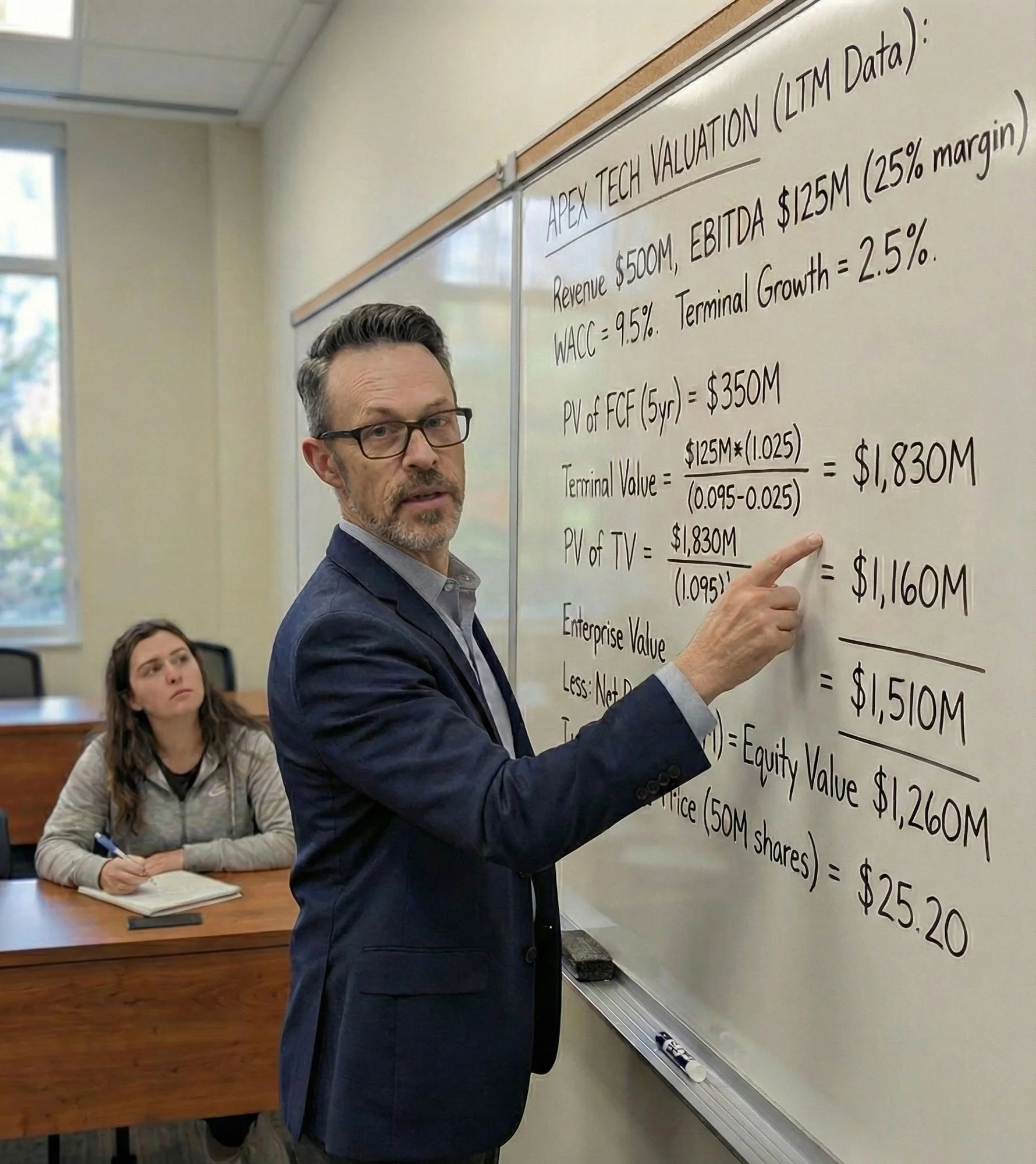
Ryan J. Ross, CFA spent 15 years managing institutional equity capital. At Bernzott Capital Advisors, he helped grow firm assets from $450 million to $1.3 billion and managed a Morningstar 5-Star rated fund. As Co-CIO and PM at McMorgan & Company, he built a new equity strategy from inception to $115 million in AUM.
For over a decade, Ryan has taught finance courses at the university level — both undergraduate and MBA courses. He is currently the faculty advisor on a $2 million student-managed investment fund at CSUN.
That combination — active practitioner and experienced educator — is what makes these sessions work. Ryan doesn't just know how professional investing operates. He knows how to make that knowledge accessible and valuable to students who are encountering it for the first time.
"Before those classes, finance felt theoretical and noisy, like it wasn't connected to real life at all. What made him different is that he wasn't just an educator. He brought real industry experience into every lesson. He taught the way analysts actually worked — focusing on true value drivers, stripping out all non-material assumptions, and connecting the narrative to the model."
— Vijay Amarshi, former student

Interested in bringing this to your program?
Happy to have a conversation about whether this would be a good fit. Sessions are delivered live via video and designed to work alongside whatever you're already doing. Pricing is designed to work within university and student budgets.